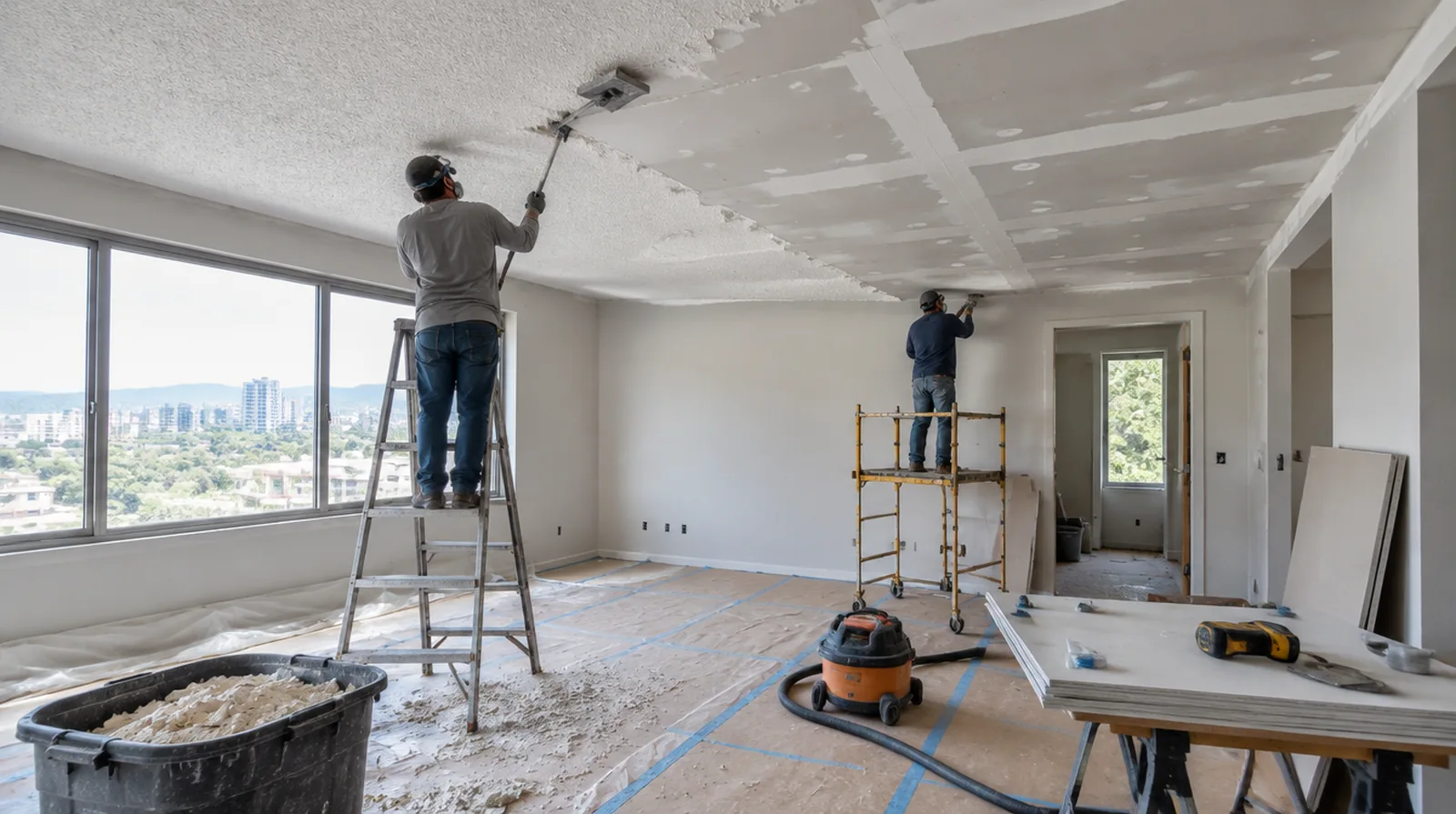
Avoid unnecessary saturation
Avoid a process that introduces so much water that it damages the supporting gypsum. The assessment needs to consider how the original finish responds and what the substrate can tolerate. For a small repair with extensive setup, compare the total scope rather than assuming the price should follow the hole dimensions alone.
Review ceiling condition
A textured ceiling can hide old repairs and seams that were never prepared for a smooth appearance. Allow for assessment and further finishing after safe removal exposes the original face. At a surface receiving strong window light, review a dried trial from the side in addition to the normal straight view of the wall.
Separate specialist work
Removal of a confirmed hazardous coating requires the relevant specialist process, not ordinary ceiling scraping. Have an suitable professional address containment, disposal and handling before subsequent drywall finishing is arranged. If the problem developed after another renovation, explain which nearby materials or building systems changed before the damage became visible.
Repair exposed imperfections
Scraping can reveal torn paper, dents and joint defects that need stabilization before a new finish. Discuss an allowance for those repairs before the decorative coating has been taken down. For a project involving a building manager, confirm access hours and protection requirements before promising a start date or a short completion window.
Protect the entire room
Ceiling removal creates overhead debris that can reach walls, floors and fixtures. Arrange masking, furniture relocation and a suitable removal route rather than covering only a small patch below. When a wall has repeated defects, keep a record of earlier repair attempts so a new assessment does not simply repeat an unsuccessful approach.
Check for painted coatings
Previously painted popcorn texture may resist simple wetting and require a differing removal approach. A small controlled assessment helps explain labor and potential damage to the underlying surface. For a tightly furnished room, plan temporary storage and the minimum working clearance before material is carried into the property.
Choose the final surface
The intended replacement finish should be selected before the removal and restoration work is priced. A new patterned finish and a flat smooth ceiling can need substantially differing preparation. In a room with little free floor space, identify temporary storage for belongings and establish adequate clearance for the work before delivery.
Plan fixture coordination
Light fittings, alarms and other ceiling devices may need separate handling by the appropriate trade. The scope should identify who disconnects and reinstalls them rather than leaving that responsibility unclear. While a removed panel exposes the wall cavity, complete the necessary review of concealed work before replacement board closes the opening.
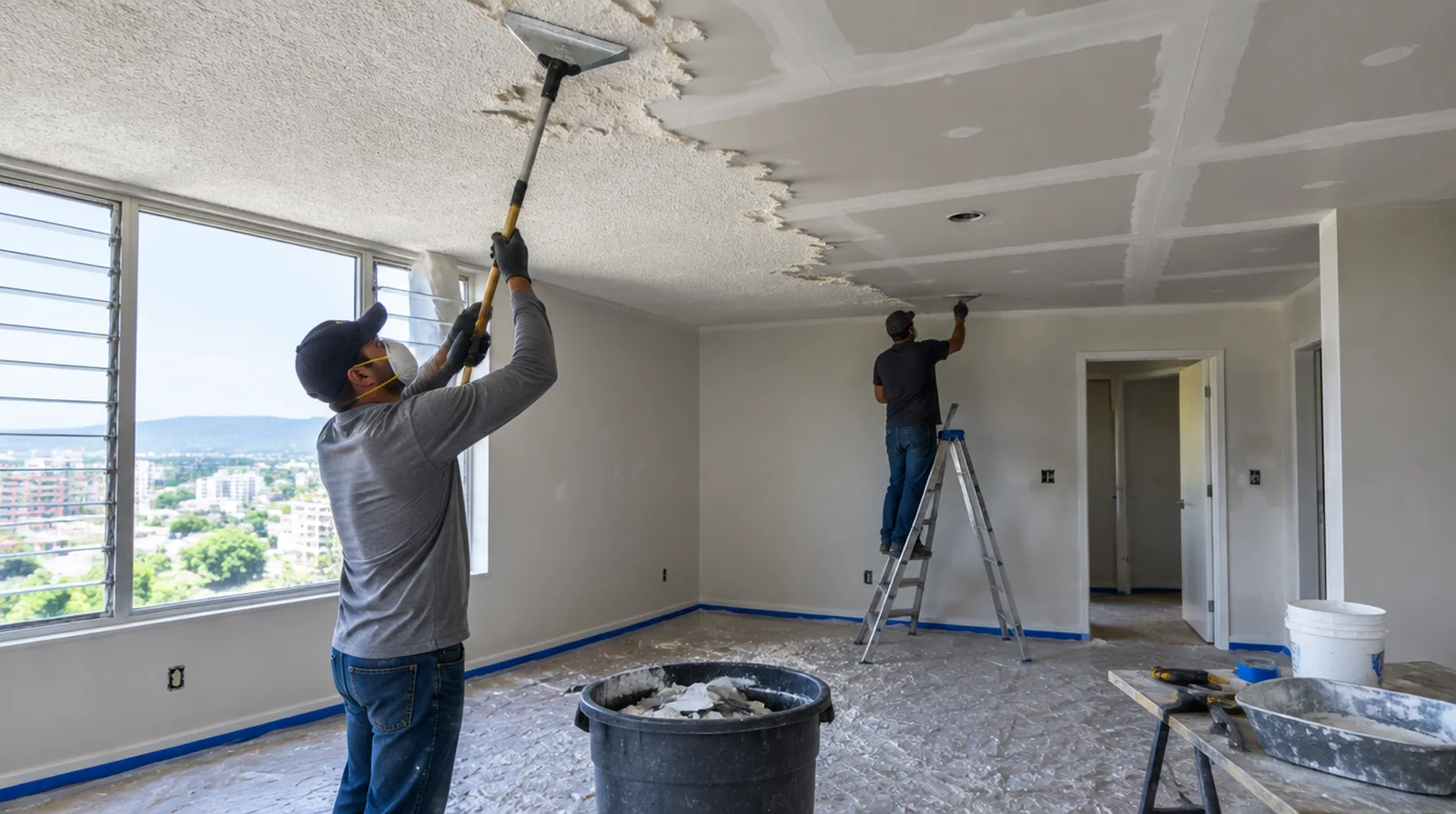
Confirm primer and paint
Plan compatible primer and paint for the exposed ceiling once repairs and finishing are dry. Define whether decoration is included or whether the drywall handover ends at preparation for coatings. If the wall surface work belongs to a broader renovation, coordinate its order with flooring, cabinetry and trim rather than scheduling finishing in isolation.
Account for side lighting
Windows and ceiling fixtures can expose shallow ridges once the heavy texture is gone. A wider skim or more extensive finishing may be appropriate for an original surface not built to remain smooth. When the decorative coating has been selected, tell the finisher its intended sheen and color while the surface preparation standard is still being agreed.
Project context in Guaynabo
After a storm, wet gypsum and rusted track should be removed completely before new board is installed. Drying time between coats here depends on keeping the room closed and the air conditioning running.
Scope questions before finishing
If access passes through a shared space, arrange protection and a delivery route that do not unnecessarily obstruct other occupants.
Where a finished perimeter is prominent, decide whether trim stays in position or is removed before agreeing how the new surface meets that edge.
For walls beside bright windows, review a dry sample from an oblique angle as well as looking straight at the repaired surface.
For a project with several trades, agree which inspection or handover point must happen before the next person starts work.
At the handover inspection, review the finish from ordinary room positions using the lighting conditions that were agreed for the work.
For a distinctive existing pattern, retain a reference sample or detailed picture to make the matching discussion more specific.
Where the wall surface meets fixed furniture, clarify whether removal is included or whether the finish will terminate at the accessible edge.
For a surface carrying numerous paint layers, discuss whether differences in the retained profile or sheen justify decorating a broader area.
Where light reflects along the wall, inspect the complete plane instead of limiting the review to the edge immediately next to the repaired section.
At a repair beside an opening, allow clearance for moving board through the doorway and space to use the finishing tools effectively.
For a limited patch requiring substantial setup, assess the complete package of access and protection rather than relating cost only to the opening size.
When the history of a repair is uncertain, note when it became visible and whether its appearance has altered across different seasons.
Explore the Guaynabo drywall overview for related options, or read the project planning information before arranging the next stage.
More planning details for Guaynabo
Condensation near split air conditioners can stain gypsum ceilings in humid Guaynabo rooms. Where a new partition meets a concrete ceiling, a flexible joint detail helps prevent a recurring crack. Guaynabo homes are mostly concrete, so drywall work usually involves interior partitions and ceilings that meet masonry.